







Why this matters
The Middle East doesn’t stay regional for long. When violence escalates, it ripples into oil risk premiums, shipping insurance, refugee pressures, diplomatic alignments, and the global information war. And when it cools—especially if it cools unevenly—it creates a different kind of uncertainty: Who governs, who pays, and who guarantees security?
Past connections: how we got here
The latest phase of the Gaza ceasefire sits on top of older fault lines: the unresolved Palestinian statehood question, internal Palestinian political divisions, shifting regional alliances, and cycles of war-reconstruction-war. Ceasefires historically fail when they postpone the hardest decisions: security control, political legitimacy, and reconstruction authority.
Current scenario (Jan 15, 2026)
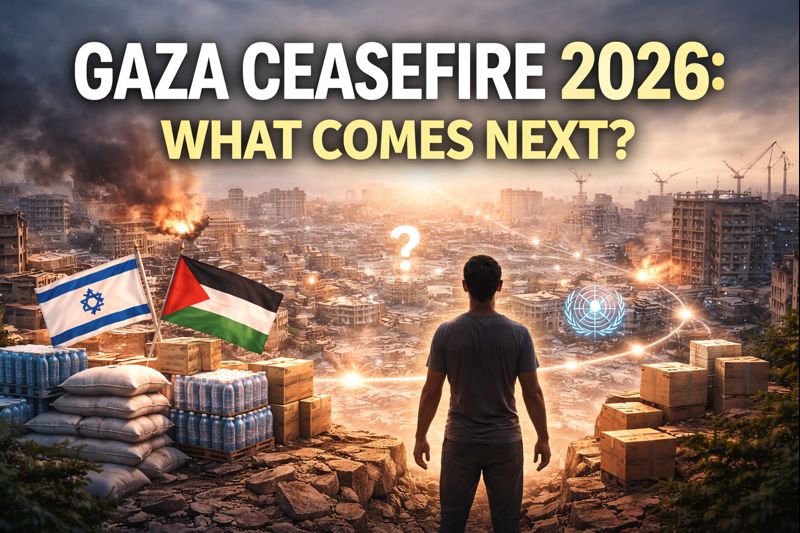
Multiple credible reports describe the ceasefire as fragile, with disputes around implementation and the “second phase” being described as symbolic or uncertain depending on the source.
Meanwhile, international attention is increasingly moving from “stopping violence” to “what governance mechanism exists after violence.” That shift matters because reconstruction requires money, security guarantees, and administrative legitimacy—and those are exactly the contested areas.
Future implications: what to watch next
- Governance architecture in Gaza
If a workable administrative structure emerges, investors and states may support rebuilding. If it collapses, humanitarian and security risks return fast. - Regional spillover risks
Even with reduced major fighting, secondary fronts and political tensions can flare, keeping the region fragile and unpredictable. - Global trade knock-on effect: the Red Sea test
When the Middle East cools even slightly, trade routes react immediately. A major indicator: Maersk said it will resume Red Sea/Suez Canal transits for a key service, pointing to improved conditions linked to the Gaza ceasefire.
Translation: the world economy feels Middle East stability through shipping times, costs, and supply chain reliability.
Bottom line: The ceasefire isn’t the finish line—it’s the start of the hardest phase: governance, reconstruction, and enforcement credibility.