








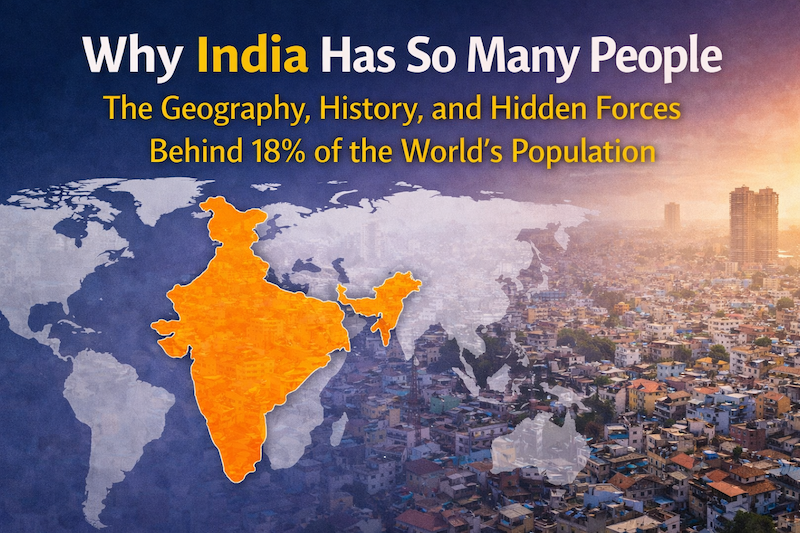
India is currently the most populous country in the world, with over 1.46 billion people—representing nearly 17–18% of the entire global population.
What makes this even more remarkable is that India occupies only about 2.4% of the world’s land area while supporting over 18% of its people.
This raises an important question: Why does India have such a high population compared to the rest of the world?
The answer lies in a combination of geography, history, culture, economic development, and demographic momentum.
Let’s explore each factor in detail.
Understanding the World Population: A Historical Perspective
To understand India’s population, we must first understand global population growth.
The world population has grown dramatically over the past few centuries:
- 1800: ~1 billion
- 1900: ~1.6 billion
- 1950: ~2.5 billion
- 2000: ~6.1 billion
- 2023: ~8.09 billion
- 2100 (projected): ~10.4 billion
This massive growth occurred due to improvements in medicine, agriculture, sanitation, and industrialization.
India played a major role in this global population increase.
India’s population alone grew from about 361 million in 1951 to over 1.4 billion today.
This means India’s population has nearly quadrupled in just 70 years.
India vs World Population: A Numerical Comparison
Let’s compare India with the rest of the world:
| Factor | India | World |
|---|---|---|
| Population share | ~17–18% | 100% |
| Land area share | ~2.4% | 100% |
| Population density | 382–488 per km² | ~51 per km² |
| Total population | ~1.46 billion | ~8 billion |
India’s population density is nearly 7–9 times higher than the global average.
This shows how densely populated India truly is.
Geographical Reasons Why India Has a Large Population
Geography is one of the most important factors behind India’s high population.
1. Fertile River Plains
India has some of the world’s most fertile agricultural lands, especially:
- Indo-Gangetic Plain
- Ganges River Basin
- Brahmaputra Valley
These regions provide fertile soil and abundant water, allowing agriculture to support millions of people.
Historically, fertile land always attracts large populations.
This is why most of India’s population is concentrated around river systems.
2. Favorable Climate
India’s climate supports year-round agriculture.
Key advantages include:
- Monsoon rains
- Long growing seasons
- Diverse ecosystems
This allows multiple crops per year, increasing food production.
More food supports more people.
3. Large Habitable Land Area
India has a land area of nearly 3 million square kilometers.
This large habitable area allows many people to live and work.
Unlike deserts or frozen regions, most of India is suitable for human settlement.
4. Coastal Access and Trade
India has over 7,500 km of coastline.
Historically, coastal regions encouraged:
- Trade
- Urbanization
- Migration
These factors contributed to population growth.
Historical Reasons for India’s Large Population
1. Ancient Civilization and Continuous Settlement
India has been continuously inhabited for over 5,000 years.
Unlike regions where populations declined due to war or environmental collapse, India maintained population stability.
This created a large population base.
2. Agricultural Economy
For thousands of years, India’s economy was agriculture-based.
Agricultural societies tend to have higher birth rates.
Families needed more children for farming.
3. Population Growth After Independence
India’s population grew rapidly after 1950.
Reasons include:
- Improved healthcare
- Reduced death rates
- Increased life expectancy
India’s population increased from:
- 238 million in 1901
- 361 million in 1951
- 846 million in 1991
- 1.4+ billion today
This massive growth happened within a single century.
Demographic Momentum: The Key Hidden Factor
Even though India’s birth rate is declining, population continues to grow.
This is called demographic momentum.
India has a young population.
More young people means:
- More marriages
- More births
Even with lower fertility rates, population growth continues.
Population Density: India vs Other Countries
India’s density is extremely high compared to global averages:
- India: ~382–488 people per km²
- World average: ~51 people per km²
This means India has far more people living in the same amount of space.
Cultural and Social Factors
Social factors also contributed to population growth.
These include:
- Early marriages historically
- Preference for larger families
- Rural agricultural lifestyle
Over time, urbanization has reduced birth rates.
Urbanization and Modern Population Growth
India’s cities are growing rapidly.
Urban areas attract people because of:
- Jobs
- Education
- Healthcare
Cities like Mumbai, Delhi, and Bengaluru are among the most densely populated in the world.
Urbanization increases population concentration.
How India Compares With China, Europe, and USA
India vs China:
- India: 1.45 billion
- China: 1.42 billion
- India is denser and growing faster.
India vs Europe:
- Europe population declining
- India population growing
India vs USA:
- India population over 4 times larger
India’s demographic structure is unique.
India’s Future Population: What Will Happen Next?
India’s population growth is slowing.
India’s fertility rate has already fallen below replacement level.
Future projections:
- India will remain most populous country until 2100
- Population expected to peak around 1.7 billion by early 2060s
- Growth will stabilize afterward
Eventually, India’s population will stabilize like developed countries.
Why Asia Has More People Than Other Continents
Asia holds over half of the world’s population.
Reasons include:
- Fertile land
- Ancient civilizations
- Favorable climate
India is part of this pattern.
Key Reasons Why India Has So Many People (Summary)
India’s high population is due to:
Geographical factors:
- Fertile land
- Favorable climate
- River systems
Historical factors:
- Ancient continuous settlement
- Agricultural economy
Demographic factors:
- Young population
- Population momentum
Social factors:
- Large families historically
Economic factors:
- Improving healthcare
- Increased life expectancy
Final Conclusion: India’s Population Is a Result of Geography and History
India’s population is not accidental.
It is the result of:
- Favorable geography
- Long history of settlement
- Agricultural productivity
- Demographic momentum
India’s population will stabilize in the future, but its demographic influence will remain globally significant.
India will continue to shape the future of global economics, geopolitics, and development.