







From Venezuela to U.S. Streets: How Trump’s Policies Are Reshaping 2026
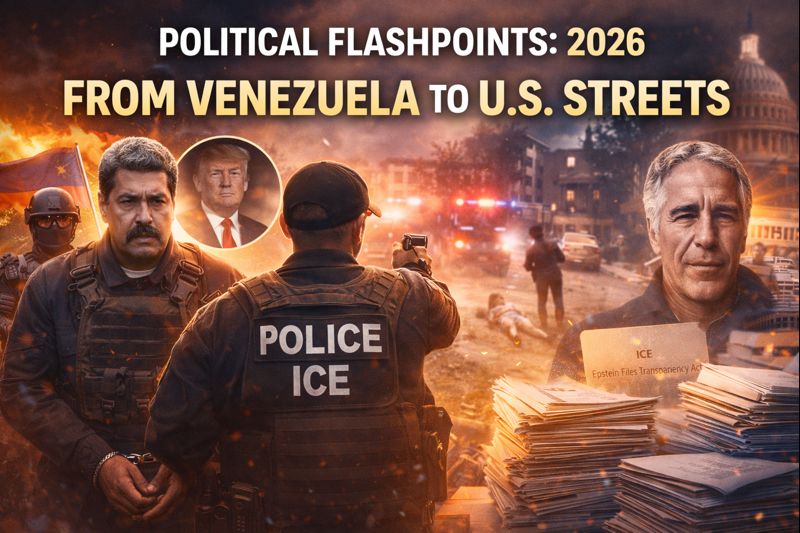
The year 2026 has already delivered political shocks that few would have predicted just months ago. From a dramatic U.S. military operation inside Venezuela that resulted in the capture of President Nicolás Maduro, to growing domestic outrage after an ICE operation killed a civilian woman, and renewed focus on transparency in the Jeffrey Epstein case, the United States is at the center of a rapidly intensifying political storm.
These events may appear disconnected, but they are tied together by deeper themes: executive power, law enforcement authority, international law, and public trust in institutions.
Let’s explore how past tensions led to this moment, what exactly is happening now, and what it may mean for the future.
U.S. Operation in Venezuela: From Sanctions to Regime Capture
🔙 Past Context: Years of Pressure on Caracas
For over a decade, Venezuela has been under heavy U.S. sanctions due to allegations of authoritarian governance, human rights abuses, and narcotics trafficking. President Nicolás Maduro had been formally indicted in U.S. courts years earlier on drug-related charges, but remained protected by his position as head of state.
Historically, the U.S. avoided direct military action, relying instead on sanctions, diplomatic isolation, and support for opposition figures.
That restraint changed dramatically in January 2026.
Current Scenario: Maduro Captured and Flown to the U.S.
In early January, U.S. forces carried out military strikes inside Venezuelan territory and captured President Maduro and his wife, Cilia Flores. Both were flown to the United States and transferred to federal custody in New York, where they face longstanding criminal charges related to narcotrafficking and organized crime .
The Trump administration described the operation as a law-enforcement action, not a war, arguing that the president had authority to execute arrests under existing indictments.
However, many legal scholars and international governments strongly disputed this interpretation, stating that forcibly entering another country to capture its sitting president constitutes a violation of national sovereignty and international law .
Meanwhile, the U.S. continues to seize oil tankers linked to Venezuela as part of sanctions enforcement, tightening economic pressure on the country’s remaining exports .
Venezuela’s vice president Delcy Rodríguez is currently serving as acting head of government, promising stability and signaling willingness to negotiate internationally.
Future Implications: Dangerous Precedent or New Power Politics?
This intervention could reshape international norms in troubling ways:
- It may encourage powerful nations to justify cross-border operations using criminal indictments.
- Latin American governments fear long-term instability and increased militarization.
- Energy markets remain sensitive to disruptions in Venezuelan oil flows.
Most analysts agree that even if the Maduro government collapses, Venezuela’s recovery will take years due to infrastructure damage and institutional breakdown.
ICE Shooting Incident: Immigration Enforcement Under Fire
🔙 Past Context: Long-Standing Controversy Around ICE
U.S. Immigration and Customs Enforcement (ICE) has faced criticism for years over aggressive detention practices, racial profiling, and limited transparency. Deportation enforcement has always been politically sensitive, but recent policy shifts have expanded ICE operational authority.
Current Scenario: Woman Killed During ICE Operation
In early January, an ICE officer fatally shot a woman during an immigration enforcement operation in Minneapolis. Federal officials initially described the incident as self-defense, but local authorities and witnesses challenged that account, calling the operation reckless and poorly coordinated .
The incident sparked protests, civil rights investigations, and lawsuits from advocacy groups arguing that immigration enforcement has become excessively militarized.
Several U.S. citizens have also filed lawsuits alleging wrongful detention and intimidation by ICE agents during recent operations .
Future Implications: Policy and Political Fallout
This case may accelerate:
- Federal oversight reforms of immigration enforcement
- Increased state-level resistance to ICE cooperation
- Heightened political polarization over immigration
With national elections approaching, immigration enforcement tactics are once again becoming a central campaign issue.
Epstein Files: Transparency Law, Not New Revelations
🔙 Past Context: Public Distrust After Epstein’s Death
Since Jeffrey Epstein’s death in federal custody in 2019, public distrust around elite accountability and hidden networks has remained high. Multiple investigations failed to satisfy widespread suspicion about political protection and sealed documents.
Current Scenario: Epstein Files Transparency Act
In late 2025, Congress passed the Epstein Files Transparency Act, requiring the U.S. Department of Justice to release unclassified Epstein-related records to the public over time. The law aims to rebuild trust by making case materials accessible, subject to privacy and victim-protection limits.
Importantly, there are no new criminal revelations released yet. What exists is a legal requirement for future document disclosure, not proof of additional wrongdoing by new individuals at this stage.
Future Implications: Public Trust vs. Institutional Limits
As records are gradually released:
- Some political figures may face renewed scrutiny.
- Conspiracy narratives may intensify regardless of evidence.
- Victim-privacy concerns will shape what becomes public.
Transparency may help restore trust, but it may also fuel further polarization.
The Bigger Picture: A Crisis of Authority and Accountability
Though these events seem unrelated, they share common threads:
| Theme | Venezuela | ICE Incident | Epstein Files |
|---|---|---|---|
| Executive power | Cross-border military arrest | Expanded enforcement authority | DOJ disclosure obligations |
| Legal controversy | International law violations | Civil rights questions | Limits of transparency |
| Public trust | Global legitimacy concerns | Domestic accountability debate | Elite immunity fears |
What unites them is a growing global and domestic debate over how much power governments should wield — and how transparently they must use it.
What Comes Next in 2026?
Expect the following trends to intensify:
- Legal battles over presidential authority in foreign operations
- Human rights litigation surrounding federal enforcement agencies
- Geopolitical instability in Latin America and oil markets
- Transparency demands across political and judicial institutions
Whether these pressures lead to reform or further polarization remains uncertain.
But one thing is clear:
2026 is shaping up to be a year where power, law, and legitimacy collide on multiple fronts — at home and abroad.